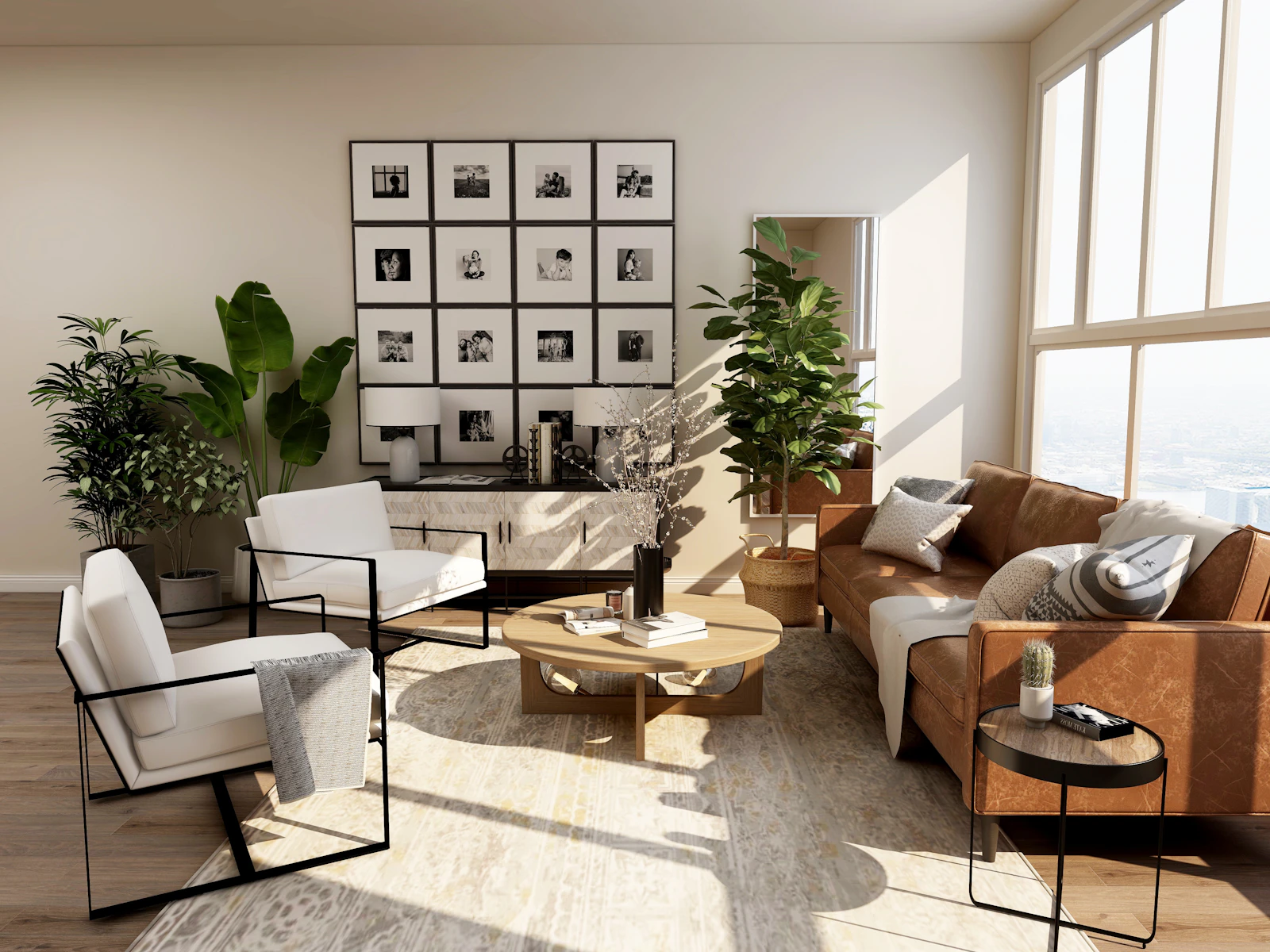
How to Redesign a Living Room with AI Using Your Photos
Step-by-step: photograph your living room, upload it, pick a style, and redesign furniture, paint and floors with AI before you buy anything.

Most living room regrets start the same way: you buy the sofa, paint the walls, then realize the whole combination looks wrong in your light. AI does not fix that after the fact. It lets you see the combination on your photo first.
I’m Daniel Htut, CEO of BasedFrame. We build an AI interior design tool, so I’m biased toward using AI for this. I’m also clear about what it cannot do. The steps below are the process I recommend to homeowners, agents and designers who want a living room redesign without guessing. Cost figures come from published sources, linked inline and listed at the end.
Why start with a photo of your room
Stock mood boards lie about scale and light. Your living room has a specific window orientation, a ceiling height, a fireplace that may or may not sit on center, and furniture that already owns floor space. An AI redesign that keeps those fixed elements—and only swaps what is movable—answers a sharper question: what would this room look like in Japandi, Mid-century or Modern Farmhouse?
That matters because the living room is expensive to get wrong. Angi puts the average living room remodel at $8,000, with most projects between $2,500 and $15,000. Fixr reports the same national average of $8,000 for a typical 250 sq.ft. living room. Cosmetic renovations land lower ($2,500–$10,000 on Angi); full remodels with layout changes run higher ($7,000–$25,000+). Seeing options on your own photo before you spend that money is the whole point.
If you are selling rather than renovating, the living room still leads. The National Association of Realtors’ 2025 Profile of Home Staging found that staging the living room was most important for buyers (37%), and sellers’ agents staged living rooms more than any other room (91%). Photos that help people visualize the space still carry weight.
What you need before you start
- A phone or camera
- Daylight or mixed lighting with the room lights on
- 10–20 minutes for photos and a first batch of redesigns
- Optional: a tape measure and a short list of pieces you already own and want to keep
You do not need an empty room, a floor plan or a design brief. Those help later. They are not required for a first pass.
Step 1: Photograph the living room the way AI likes it
AI redesign quality tracks photo quality. Real estate photographers and staging services have been saying this for years; the same habits help AI tools.
Stuccco’s virtual staging photography checklist recommends cleaning surfaces, shooting horizontal, keeping the camera level, and photographing from corners so you see floor and focal point. Adapted for a living room redesign:
- Clear clutter from surfaces, even if furniture stays. Remotes, laundry piles and kids’ toys confuse both humans and models.
- Open blinds and curtains unless the view is truly bad. Turn on every light so shadows are soft and even.
- Stand in a corner at about chest height (roughly waist to mid-torso on a phone), camera level—do not tilt down at the floor. Stuccco notes that high, tilted shots shrink the room and leave too little floor for furniture.
- Shoot horizontal and take photos from opposite corners. One wide shot of the main seating wall is usually enough for a redesign; two angles help if the room is L-shaped or open to a dining area.
- Save a high-resolution JPG, ideally at least about 2,000 pixels on the long edge if your phone offers it.
If the best shot you have is dark, yellow or slightly crooked, run Enhance Photo (1 credit) before anything else. Clean input is cheaper than regenerating a bad redesign.
Step 2: Upload and run a full Room Redesign
Open Room Redesign (2 credits), upload your photo, set the room type to Living room, and pick a style. BasedFrame keeps the walls, windows, doors, ceiling and camera angle, then restyles furniture, decor and finishes to match the style you chose.
For a first pass I suggest three styles that behave differently in living rooms:
- Japandi — low oak, linen, negative space; good if your room feels crowded
- Mid-century — walnut, tapered legs, warmer accent colors; good if you want character without clutter
- Modern Farmhouse or Coastal — softer neutrals; good for family rooms and bright light
Generate all three from the same photo so you are comparing style, not camera angle. Drag the before-and-after slider. Ask yourself which one feels like a place you would actually sit on a Tuesday night—not which one looks most like a magazine cover.
If nothing lands, try one more style from our guide to 12 interior design styles, or run Style Transfer with a reference image of a room you love. Style Transfer is useful when you cannot name the look but can point at it.
Step 3: Lock the winner, then change one thing at a time
A full redesign is for choosing a direction. After that, stop reseeding the whole room and edit surgically. That is how you avoid chasing a moving target.
| Goal | Tool | Credits |
|---|---|---|
| Clean up a dark or tilted photo | Enhance Photo | 1 |
| Try a new overall look | Room Redesign | 2 |
| Change only wall color | Walls & Paint | 1 |
| Change only the floor | Flooring Swap | 1 |
| Drop a real sofa or chair into the scene | Furniture Swap | 2 |
| Apply the look of a reference photo | Style Transfer | 3 |
A practical sequence after you pick a favorite redesign:
- Paint. Try two wall colors on the same base image with Walls & Paint. Angi notes professional painting often runs about $2 to $6 per square foot including labor and materials—cheap relative to a full remodel, expensive relative to a wrong gallon.
- Floor. Preview hardwood, light oak, carpet or tile with Flooring Swap before you commit. Angi lists installed hardwood around $6 to $15 per square foot; laminate is often less.
- Hero furniture. Upload a product photo of a sofa you are considering and place it with Furniture Swap. The room stays yours; only the piece changes. Measure the real wall before you order.
New accounts start with 30 free credits on BasedFrame. That is enough for several full redesigns plus paint and flooring tests. Paid plans are on our pricing page; the Startup plan is $49 a month for 180 credits.
DIY mood boards vs AI vs hiring help
| DIY mood boards | AI redesign from your photo | Designer or remodel | |
|---|---|---|---|
| Typical cost | Free–low (time + samples) | A few credits per render; 30 free credits to start | Living room remodel avg. ~$8,000 (Angi / Fixr); designer fees extra |
| Time to first concept | Hours to days | About a minute per render | Days to weeks for concepts; weeks to months to build |
| Uses your real room | Rarely | Yes | Yes, with site visits |
| Number of looks you can try | Limited by time | As many as your credits allow | Limited by billed hours |
| Measured plans and trades | No | No | Yes |
| Best for | Collecting inspiration | Deciding style, paint, floor and furniture on your photo | Construction, custom built-ins, project management |
Use AI to decide. Hire people to build. Mixing the two—AI concepts as a brief for a designer—is often the cheapest path into a paid project. We wrote a longer comparison in AI interior design vs hiring a designer.
A one-hour living room workflow
If you want a concrete schedule:
Minutes 0–10. Photograph two corners. Pick the sharper, better-lit frame. Enhance if needed.
Minutes 10–25. Run Room Redesign in three styles. Save the one you would live with.
Minutes 25–40. On that winner, try two paint colors and one flooring option.
Minutes 40–55. Furniture Swap any sofa or chair you already have in a shopping cart. Discard anything that crowds the walkway or blocks a window.
Minutes 55–60. Export your favorites and write a one-line brief: style name, wall color, floor type, keep/replace list. That brief is what you take to a store, a contractor or a designer.
Agents listing a vacant or dated living room can swap step 2 for Virtual Staging after Empty the Room. Our virtual staging guide covers disclosure and MLS habits. If you want to preview remodel ideas across a whole listing, Listing Remodel imports listing photos in bulk.
Common mistakes (and how to avoid them)
- Bad source photos. Tilted, dark, ultra-wide phone shots produce weird furniture scale. Reshoot from a corner, level, with lights on.
- Redesigning forever. Cap full redesigns at three or four styles, then switch to paint/floor/furniture edits.
- Treating renders as measured drawings. AI does not know that your sofa is 92 inches or that the radiator sticks out four inches. Measure before you buy.
- Ignoring the light you already have. North-facing rooms look cooler; west-facing rooms go warm in the evening. Choose paint and wood tones that work in your actual light, not only in the render.
- Hiding problems. AI should show potential. It should not paint over water stains buyers will see in person if you are selling.
- Skipping disclosure on listings. Many MLSs require you to label virtually staged or digitally altered photos. Keep originals beside the redesigns.
What AI still cannot do
It will not move a load-bearing wall, price a built-in correctly for your zip code, or manage a flooring crew. Angi notes general contractors often charge 10% to 25% of project cost to oversee remodels, and designers commonly bill $50 to $200 an hour on living room work. If your plan includes electrical, structural changes or custom millwork, use AI for the look and a pro for the build.
AI also cannot shop trade pricing or guarantee a product is in stock. Furniture Swap shows how a piece looks in your room. Your retailer still owns availability and returns.
Sources
Figures checked on October 18, 2026:
- Angi, “How Much Does It Cost to Remodel a Living Room? [2026 Data]”: angi.com
- Fixr, “Cost to Remodel Living Room”: fixr.com
- National Association of Realtors, press release on the 2025 Profile of Home Staging (May 6, 2025): nar.realtor
- Stuccco, “How to Take Photos for Virtual Staging”: stuccco.com
- BasedFrame credit costs and plans: basedframe.com/pricing
The bottom line
Redesigning a living room with AI is not a replacement for craftsmanship. It is a way to freeze the expensive decisions—style, paint, floor, sofa—on a photo of the room you already have. Photograph carefully, run a few full redesigns, then edit one variable at a time. When the image looks like home, measure twice and buy once.
Ready to try it on your own living room? Start free with your photos—new accounts get 30 credits, no card required.
Frequently asked questions
Can AI redesign my living room from a phone photo?
Yes. A clear smartphone photo taken from a corner at chest height works well. Open the blinds, turn the lights on, and keep the camera level. If the shot is dark or tilted, run Enhance Photo first, then Room Redesign.
How much does an AI living room redesign cost?
On BasedFrame, Room Redesign costs 2 credits. Walls & Paint and Flooring Swap each cost 1 credit, and Furniture Swap costs 2. New accounts start with 30 free credits, so you can try several looks before paying. A physical living room remodel averages about $8,000 according to Angi and Fixr.
Will AI keep my walls, windows and layout?
Room Redesign keeps the architecture of your photo—walls, windows, doors, ceiling and camera angle—and replaces furniture, decor and finishes. Treat the result as a concept, not a measured plan. Check real product dimensions with a tape measure before you buy.
Should I empty the room before I photograph it?
Not required. You can redesign a furnished room as-is. If the space is cluttered or you want a clean slate for staging, run Empty the Room first, then redesign or stage. Clearing personal clutter from surfaces still helps the AI read the space.
How many styles should I try on the same photo?
Start with three or four that interest you—Japandi, Mid-century, Modern Farmhouse and Coastal are common living room picks. Save the winners, then refine with paint, flooring or a specific sofa. More than about six full redesigns usually adds noise, not clarity.
Is AI redesign useful if I am listing a home for sale?
Yes. NAR's 2025 Profile of Home Staging found the living room was the most important room to stage for buyers (37%), and sellers' agents staged living rooms most often (91%). Label virtually altered photos if your MLS requires disclosure, and keep the originals.
Try it yourself
Tools from this guide
 2 creditsRoom RedesignRestyle any room photo in a new design style.Open tool →
 1 creditWalls & PaintTry paint colours, wallpaper and panelling.Open tool →
 1 creditFlooring SwapPreview oak, terrazzo, tile or carpet underfoot.Open tool →
 2 creditsFurniture SwapDrop a real product into your room from its photo.Open tool →
 3 creditsStyle TransferApply the look of a reference photo to your room.Open tool →
 1 creditEnhance PhotoFix exposure, verticals and detail on listing photos.Open tool →
More from Resources
Keep reading
GuidesHow to Furnish a Small Apartment with AI Before You Buy a SofaThe average new studio is 460 sq ft. Here's how to photograph your small apartment, test layouts and furniture with AI, and buy pieces that actually fit.→
GuidesBefore You Spend $3,178 on Exterior Paint: 6 Visualizers ComparedColorSnap, Behr, Hover, Hardie Designer, real samples and AI compared: how to preview your house color before a $3,178 exterior paint job.→